
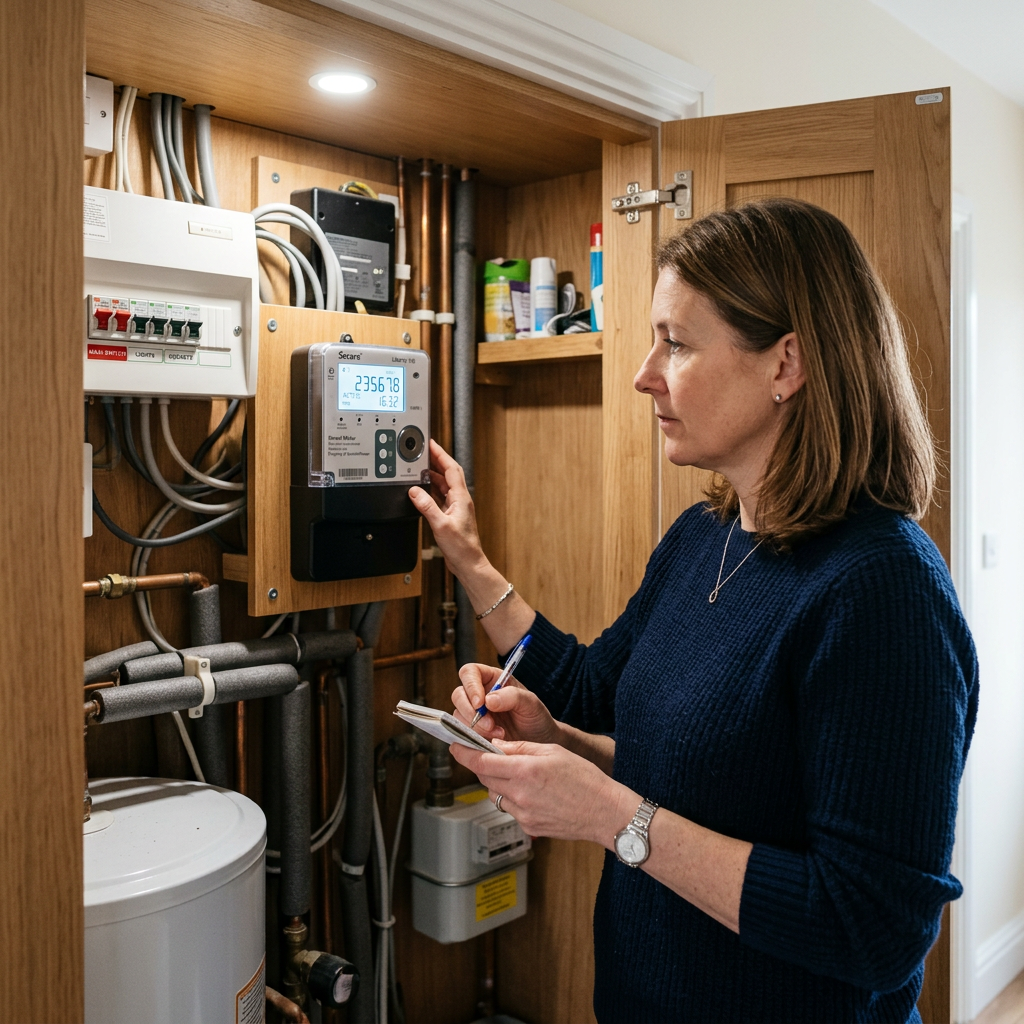
Why Your Meter Reading Matters
Millions of UK households receive estimated energy bills every year. While estimates might seem harmless, they can leave you in credit (essentially giving your supplier an interest-free loan) or in debt (facing a large catch-up bill at the worst possible time). Submitting your own accurate meter readings keeps your bills precise and puts you firmly in control.
Understanding how to read your meter correctly — and what to do with those readings — is one of the most straightforward things you can do to manage your energy costs. If you want to find the cheapest utility provider, it only takes a few minutes.
Types of Energy Meter in the UK
Before you start taking readings, it helps to know which type of meter you have.
Standard (Single-Rate) Meters
The most common type. A standard electricity meter has a single row of numbers showing your cumulative usage in kilowatt-hours (kWh). A gas meter works the same way, typically showing cubic metres (m³) or cubic feet (ft³). You can also compare utility providers to see what’s available.
Economy 7 and Economy 10 Meters
These multi-rate meters track off-peak and peak electricity usage separately, shown as two rows of numbers — usually labelled ‘low’ or ‘night’ and ‘normal’ or ‘day’. If you’re on an Economy 7 tariff, using appliances like washing machines and dishwashers overnight can significantly reduce your bill.
Smart Meters
Smart meters send readings automatically to your supplier, eliminating estimated bills entirely. They also come with an in-home display (IHD) that shows your real-time usage in pounds and pence — a genuinely useful tool for understanding which appliances are costing you most.
How to Read Your Electricity Meter
For a standard digital meter, simply read the numbers from left to right, ignoring any digits after a decimal point or shown in red. For example, if the display shows 18345.7, your reading is 18345.
For an older dial-style meter, read each dial from left to right. If the pointer is between two numbers, use the lower one. If it’s exactly on a number, note it but check the next dial — if that’s between 9 and 0, reduce your noted number by one.
How to Read Your Gas Meter
Digital gas meters work the same as digital electricity meters — read left to right, ignore red numbers or figures after the decimal point. Your reading will be in cubic metres (m³) or cubic feet (ft³).
Your supplier converts this volume into kWh for billing purposes using a calculation that accounts for the calorific value of gas and a conversion factor. You don’t need to do this yourself — just supply the raw reading.
How Often Should You Submit Readings?
Most suppliers ask for a reading every month or every quarter. As a minimum, you should submit a reading:
- When you move in — to establish your opening reading and avoid paying for the previous occupant’s usage.
- When you move out — your closing reading determines your final bill.
- Before a price change — if your tariff is increasing, submitting a reading the day before ensures you’re billed at the lower rate for everything up to that point.
- Monthly — for the most accurate bills and to catch any unexpected usage spikes early.
Smart Meters: Are They Worth Having?
If you haven’t yet had a smart meter installed, it’s worth considering. They eliminate estimated bills, allow you to track usage in near real-time, and make switching suppliers easier. Installation is free and should take around an hour. Contact your current supplier to arrange one — it’s a legal requirement for suppliers to offer them to all customers.
Use Your Readings to Find a Better Deal
Your annual energy usage in kWh — shown on your bills or calculated from your meter readings — is the key figure you need to compare tariffs accurately. Armed with this number, you can see exactly how much different deals would cost you over a year, making comparisons genuinely meaningful rather than guesswork.
Take two minutes to compare energy deals now using your meter readings. You might be surprised how much you could save by switching to a tariff that better suits your actual usage pattern.


0 Comments